Music and Devotion
December 6, 2011 Leave a comment
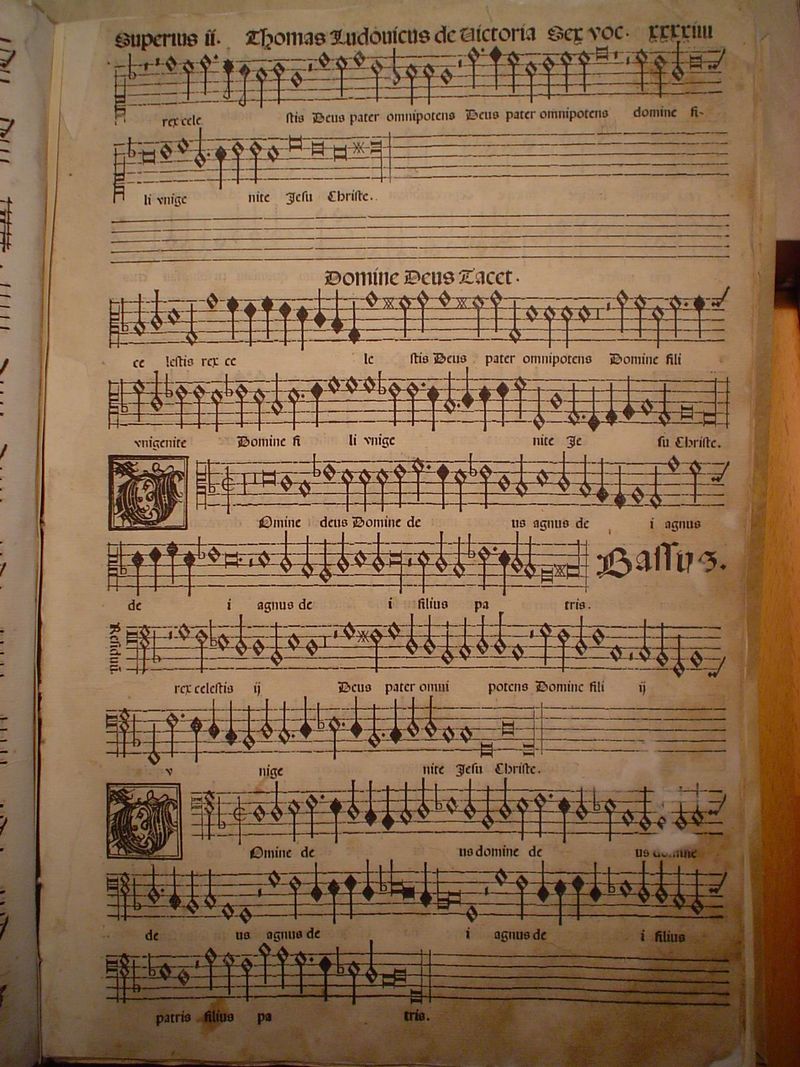
Score by Tomás Luis de Victoria
Please excuse the pun, but, increasingly, I’m finding the devotional music of the late Renaissance a serene counterpoint to the, at times, overly insistently dynamic and goal-oriented music of my guru, Beethoven. There are times when you just want music to wash over you; to carry you away; to allow yourself to be lost in the sweet and earnest beauty of its ceaselessly interweaving counterpoint.
I am vaguely familiar with only very little of this music. I am aware of just a few works of the more famous composers of this period: the Missa Pape Marcelli by Palestrina, the marvellous forty-part motet, Spem in Alium by the Tudor master of polyphony, Thomas Tallis, which at times creates a ‘wall of sound’ far move overwhelming that anything created by Phil Spector in the 1960s. One candidate for the current pop classic of this period is Allegri’s Miserere from around 1630. I love the televised version of this piece by Harry Christophers and the Sixteen, where the boy soprano is replaced by a female soprano in singing the soaring high notes, culminating in the famous top Cs. This music is hauntingly beautiful.
For anyone who is not a devout Catholic the words of much of this music can be very hard to connect with. A common theme seems to be self-abasement, verging on self-loathing, before God: “And my sin is ever before me… Against You only have I sinned and done evil in Your sight… Behold, I was brought forth in iniquity and in sin did my mother conceived me.” I find some of these sentiments obnoxious; all the more so since I believe that the most insidious effect of Roman Catholicism is to exercise its hold on the faithful by instilling in them an overpowering sense of sin from which only the Church can offer salvation from eternal torment. To me, this abuse of power is nothing short of an evil in itself (Darwin thought this to be a “damnable doctrine”).
So, how are we to respond to this music? For the most part, I like most others I suspect, have hitherto just ignore the words as I allow myself to be lost in its ethereal beauty.
However, I found a recent BBC4 programme on the Spanish 16th Century composer, Tomás Luis de Victoria (sometimes called da Vittoria), has had quite a profound impact on me; not only by providing me with an approach I might take when listening to the music of this period, but also by giving me a glimpse of what is missing from my own spiritual life, devoid as it is of any notion of a personal god.
Victoria was an ordained priest and seems to be a genuine mystic, someone who devoted himself as a man, as well as a musician, to a heart-felt contemplation of the divine. Such was his personal commitment to his spiritual calling that his music, which is less cerebrally contrapuntal than that some of his predecessors, such as Palestrina, has a direct impact on the listeners’ emotions, directly communicating his own very personal feelings of devotion, especially, to the Virgin Mary and to the story of Christ’s Passion. Much of Victoria’s music also has an ecstatic quality; in this he probably took as his example his early spiritual mentor, Teresa (later Saint Theresa) of Ávila, who was the subject of Bernini’s famous sculpture the Ecstasy of St Teresa.
I’ve concluded that the best way for me to listen to this music of this period is neither to ponder the literal meaning of the words, nor to just to let the music wash over me, inducing a mindless sense of calm. I feel there is far more to gained by engaging imaginatively in the experience that it seeks to communicate: a devotion to the highest and most beautiful ideal that can be conceived, and in so doing, to try to empty myself of all sense of self and will – a fundamental spiritual practice in its own right.
I am therefore left to ponder how we might incorporate into a non-theistic spirituality of the Global Age practices that engender contemplations of equivalent beauty and spiritual power. The Buddhist tradition is very rich in meditative practices that have developed over many centuries since the Buddha’s time, such as the Brahmaviharas – the sublime abodes, as taught by the Buddha himself, and the much later Tonglen practice. Wonderful and essential as some of the traditional practices are, my feeling is that they are not complete. Essential elements of a new spirituality would be a sense of awe and wonder at being an integral part of creation and a love for the World and a devotion to its further blossoming. For me, these explicit sentiments are completely missing from Buddhism. I therefore hope that new meditative practices will emerge that tap into the capacity that virtually everyone has (sadly, perhaps not most psychopaths) to experience what might be called the divine (our Buddha Nature as its called in Mahayana Buddhism) and in so doing, to find a devotion to a calling to bring love, beauty, joy, understanding and compassion into the World.
 The Great Dharma