Music and Devotion

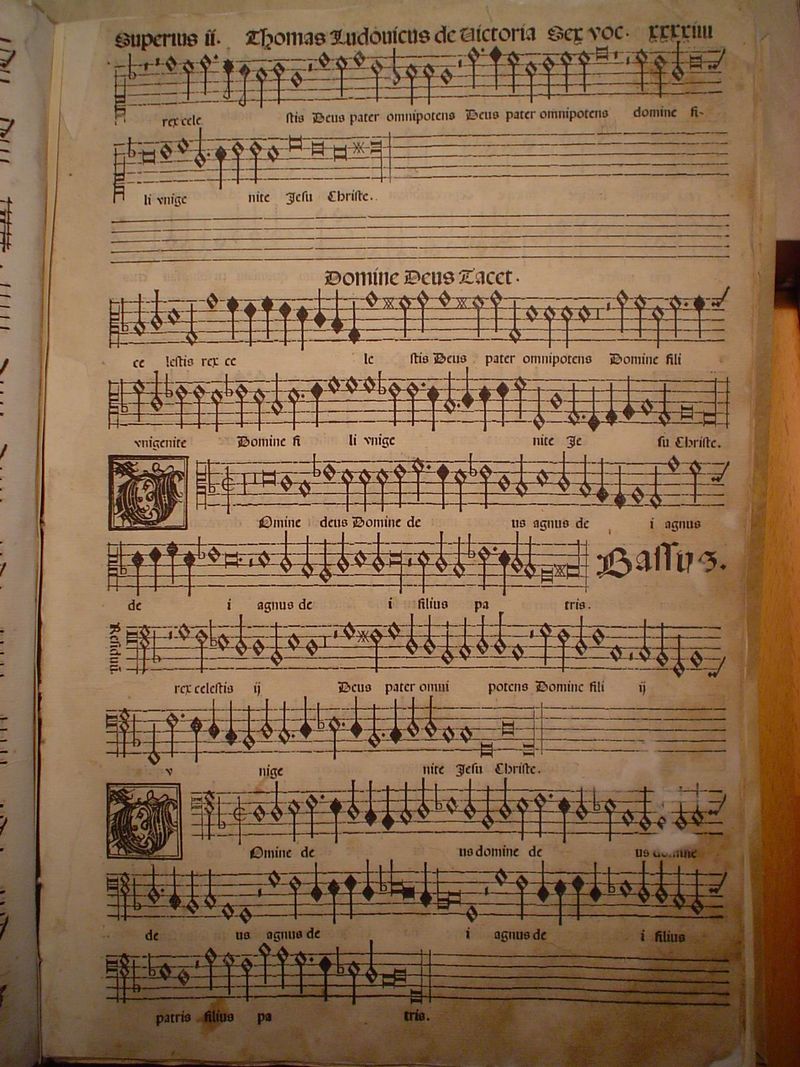
Score by Tomás Luis de Victoria

Please excuse the pun, but, increasingly, I’m finding the devotional music of the late Renaissance a serene counterpoint to the, at times, overly insistently dynamic and goal-oriented music of my guru, Beethoven. There are times when you just want music to wash over you; to carry you away; to allow yourself to be lost in the sweet and earnest beauty of its ceaselessly interweaving counterpoint.

I am vaguely familiar with only very little of this music. I am aware of just a few works of the more famous composers of this period: the Missa Pape Marcelli by Palestrina, the marvellous forty-part motet, Spem in Alium by the Tudor master of polyphony, Thomas Tallis, which at times creates a ‘wall of sound’ far move overwhelming that anything created by Phil Spector in the 1960s. One candidate for the current pop classic of this period is Allegri’s Miserere from around 1630. I love the televised version of this piece by Harry Christophers and the Sixteen, where the boy soprano is replaced by a female soprano in singing the soaring high notes, culminating in the famous top Cs. This music is hauntingly beautiful.

For anyone who is not a devout Catholic the words of much of this music can be very hard to connect with. A common theme seems to be self-abasement, verging on self-loathing, before God: “And my sin is ever before me… Against You only have I sinned and done evil in Your sight… Behold, I was brought forth in iniquity and in sin did my mother conceived me.” I find some of these sentiments obnoxious; all the more so since I believe that the most insidious effect of Roman Catholicism is to exercise its hold on the faithful by instilling in them an overpowering sense of sin from which only the Church can offer salvation from eternal torment. To me, this abuse of power is nothing short of an evil in itself (Darwin thought this to be a “damnable doctrine”).

So, how are we to respond to this music? For the most part, I like most others I suspect, have hitherto just ignore the words as I allow myself to be lost in its ethereal beauty.

However, I found a recent BBC4 programme on the Spanish 16th Century composer, Tomás Luis de Victoria (sometimes called da Vittoria), has had quite a profound impact on me; not only by providing me with an approach I might take when listening to the music of this period, but also by giving me a glimpse of what is missing from my own spiritual life, devoid as it is of any notion of a personal god.

Victoria was an ordained priest and seems to be a genuine mystic, someone who devoted himself as a man, as well as a musician, to a heart-felt contemplation of the divine. Such was his personal commitment to his spiritual calling that his music, which is less cerebrally contrapuntal than that some of his predecessors, such as Palestrina, has a direct impact on the listeners’ emotions, directly communicating his own very personal feelings of devotion, especially, to the Virgin Mary and to the story of Christ’s Passion. Much of Victoria’s music also has an ecstatic quality; in this he probably took as his example his early spiritual mentor, Teresa (later Saint Theresa) of Ávila, who was the subject of Bernini’s famous sculpture the Ecstasy of St Teresa.

I’ve concluded that the best way for me to listen to this music of this period is neither to ponder the literal meaning of the words, nor to just to let the music wash over me, inducing a mindless sense of calm. I feel there is far more to gained by engaging imaginatively in the experience that it seeks to communicate: a devotion to the highest and most beautiful ideal that can be conceived, and in so doing, to try to empty myself of all sense of self and will – a fundamental spiritual practice in its own right.

I am therefore left to ponder how we might incorporate into a non-theistic spirituality of the Global Age practices that engender contemplations of equivalent beauty and spiritual power. The Buddhist tradition is very rich in meditative practices that have developed over many centuries since the Buddha’s time, such as the Brahmaviharas – the sublime abodes, as taught by the Buddha himself, and the much later Tonglen practice. Wonderful and essential as some of the traditional practices are, my feeling is that they are not complete. Essential elements of a new spirituality would be a sense of awe and wonder at being an integral part of creation and a love for the World and a devotion to its further blossoming. For me, these explicit sentiments are completely missing from Buddhism.  I therefore hope that new meditative practices will emerge that tap into the capacity that virtually everyone has (sadly, perhaps not most psychopaths) to experience what might be called the divine (our Buddha Nature as its called in Mahayana Buddhism) and in so doing, to find a devotion to a calling to bring love, beauty, joy, understanding and compassion into the World.

Credo

Now in my sixties, each time I get into bed at night I’m aware of a background feeling of dread. Yet another day has passed all too quickly; I have a very real sense of hurtling through time towards death. I have no illusions that death is anything other than the absolute extinction of consciousness. Whilst I fear the process of dying, the thought of personal extinction does not appal me, at least whilst its not an imminent threat. I do fear that it will come all too quickly, especially since I feel that I have nowhere near achieved my potential. Life is sweet and I would not want to leave my wife and family whilst I am still able enjoy life with them. But far greater than my fear of extinction is my fear that just ahead of me might lie years of physical and mental incapacity and dependence. That seems to me to be the ultimate degradation of what life should be.

Yet I have faith, or perhaps just hope, that it is possible, whilst we are still engaged in the midst of life, to achieve a radiance of being from which joy, meaning and purpose can flow. Such a radiance of being would enable us to live creative and compassionate lives in communion with others and in a way that deepens our resilience in the face of the worst that might confront us. My hope is that if the worst happened and I became completely helpless, even unable to speak, I would still be an inspiration to those supporting me, because such radiance would still be evident, if only through a gleam in the eye or a squeeze of the hand. Perhaps my last gift would be my need for their compassion, which would ennoble them. So, perhaps, the prime goal of life ought to be to achieve such radiance, so that one’s life is transformed for the benefit of oneself, others and the World.

But how might such radiance be achieved? The mystics and seers of the World’s great religions tell us that a profound serenity, even bliss, can be achieved through deep and sustained meditation or prayer, the purpose of which is to focus our attention onto what is most fundamental about existence in that moment. It is said that in such moments one achieves a state of consciousness freed the ego-centric realms of fantasy or of a distortedly remembered past or imagined future. It is commonly reported that when the ego is overcome it can be replaced by what William James, the American philosopher called ‘cosmic consciousness’ – a sense of not being a separate entity observing the rest of reality, but of being an integral and inseparable part of all that is.

Too often it seems those who claim to have achieved such a spiritual breakthrough are in the World but not of the World. I live in hope that it is possible to achieve a radiance of being that is intimately connected to the stream of daily life of ordinary people, with all its joys, sorrows, struggles, failures and achievements. People need to a find meaning and purpose in life that is greater than themselves – something that both ennobles each life and outlives it. If, as I believe, the quest for an eternal life is both self-defeating and negation of what is most important in human life, the only entity worthy of our love and devotion that far outlives us is the World itself: the miraculous physical, ecological, cultural and social environment that gave birth to each of us and that will bear our legacy into the future. My hope, therefore, is that there is a way to live my life as a radiant and compassionate gift to the World, which is the realm of humanity’s shared existence, hopefully for millennia yet to come.

The possibility of a spiritual epiphany without God

It seems that a common aspiration in all spiritual traditions is self-transcendence. This is hardly surprising since much of religious doctrine is aimed motivating the individual to abandon self-centeredness as a moral imperative and to follow the paramount requirement to submit oneself to God. However, its clear from every spiritual tradition that some intense self-transcending practices can lead to what might be termed mystical or world-transcending experiences that provide, if only temporarily, a deep sense peace and joy and connection with the rest of creation.

Practices vary widely across all the great spiritual traditions and can involve, amongst many others, intense periods selfless prayer, group incantation, quiet meditative contemplation or even, in the case of Sufi Islam, swaying and whirling. What seems to be common is a relaxed form of deep concentration in which the sense of self, which is always most concrete when pondering the past or an imagined future, is temporarily suspended. At such times there is an acute but calm awareness, but not from the standpoint of the self, with its time-bounded obsessions of likes, dislikes, regrets, hopes and fears.

When the sense of self is overcome it is often replaced by what William James, the American philosopher called ‘cosmic consciousness’ – a sense of not being a separate entity observing the rest of reality, but of being an integral and inseparable part of all that is. There may well be physiological reasons why humans are capable of such experiences. In her well-known talk at one of the TED conferences, the neurophysiologist, Jill Bolte Taylor relates a powerful experience that she had when she suffered a huge stroke in the left hemisphere of her brain. Between periods of panic, during which she tried to overcome her impaired language and motor control in order to phone for help, she had experiences of great joy and expansiveness. During these periods she felt her body to be without boundaries and herself connected in a free exchange of energy with the whole of the rest of reality. This she attributes this experience to the suspension of those seemingly left-hemisphere functions that define our physical boundary and our sense of self as being locked in a continuum of time between past and future. Other neurological researches into mystical experiences seem to confirm that that there are indeed areas of the brain that control our sense of our body’s physical boundary and its place in space and when these are ‘switched off’ such powerful experiences can occur. Since, I take it as axiomatic that all mental processes are underpinned by physiological processes within the embodied brain (this, in my view, does not entail reductionism), I don’t think that physiological explanations of how such experiences might occur invalidate them. We know that some people taking ‘psychedelic’ drugs, such as LSD, have reported similar experiences. The point is that such experiences are very powerful, even transformative, and allow insights into the nature of existence that may well be just as valid as those everyday experiences more usually dominated by an overriding sense of a bounded, separate self navigating between past and future. Like any other experience of the world, the elapse of time, which is such a fundamental and yet such an utterly mysterious aspect of normal consciousness, is a brain-mediated. If it attenuated in any way this must lead to a profoundly different experience of reality.

Unfortunately, I have never had such a life-changing experience myself; at least not to the degree I believe some have genuinely experienced. Like almost everyone else, I have had moments of uplifting joy and, perhaps, fleeting moments of insight, usually when out walking and opening up to the beauty of the natural world or when listening to great music. A number of times I have had a delicious sensation of a lightness of being after spending a 45 minute train journey to London in a semi-meditative state cultivating goodwill towards my fellow passengers. However, I cannot claim that any of these individual experiences, all of which quickly faded, have been profoundly life changing. But I take it on trust that such epiphanies are possible and that it should be an essential part of any spiritual path to follow practices that open oneself up to the possibility of such transformative experiences occurring.

I also take it on trust that such spiritual illumination is possible without necessarily attaining sainthood or achieving perfect enlightenment in the Buddhist sense. I’m happy to be agnostic about how far any individual can approach a completely transformed state, let alone perfection, however that may be defined. But profound experiences that are blissful and that open one up to new dimensions of reality seem to be both attainable and highly desirable. However, from what I have learned in Buddhism, the pursuit of spiritual illumination as an end in itself may well be self-defeating, especially if such a quest were mainly self-serving. It seems that spiritual illumination is more likely to occur as a by-product, if we assiduously follow practices that engender selflessness, love, compassion, peace and acceptance for their own sake.

The core of any profound experience is ineffable – it that cannot be adequately explained in conceptual terms, which is perhaps why some of the very greatest artists have sought to convey their essence through the poetic and metaphorical language of the arts. However, given that such experiences are so powerful, its natural that people should want to communicate their impact and significance. This it seems to me is where the danger lies, because hitherto most attempts to explain such experiences have entailed using conceptual language drawn from the individual’s religious worldview. In so doing, they are drawn into making claims about the nature of the shared universe that can’t be justified in rational terms. Experiences of ‘cosmic consciousness’ might be explained as union with Christ, God or Allah or the liberation from the rounds of earthly rebirth or reincarnation or some other access to eternal life. Most of these claims must be mutually exclusive and so, if we’re not careful, we can slide back into the destructive cycle where our highest spiritual aspirations lead us to make exclusive claims of certainty about the world that cannot be verified and can lead to disunity at best and global conflict at worst.

The great challenge for the humanistic spirituality that the world so desperately needs as it enters the Global Age, is to discover a great new spiritual vision (a great dharma, to use a Buddhist term), partly inspired by the awesome panorama provided by science, of humanity’s place in nature. Such a dharma would allow us to see a connection between moments of epiphany and our everyday lives, without the need for unverifiable claims, but in a way that enlarges our capacity to live our lives joyfully and compassionately as gift to all beings and to this world, which is the realm of humanity’s shared existence, hopefully for millennia yet to come.